
Dishwasher buying guide

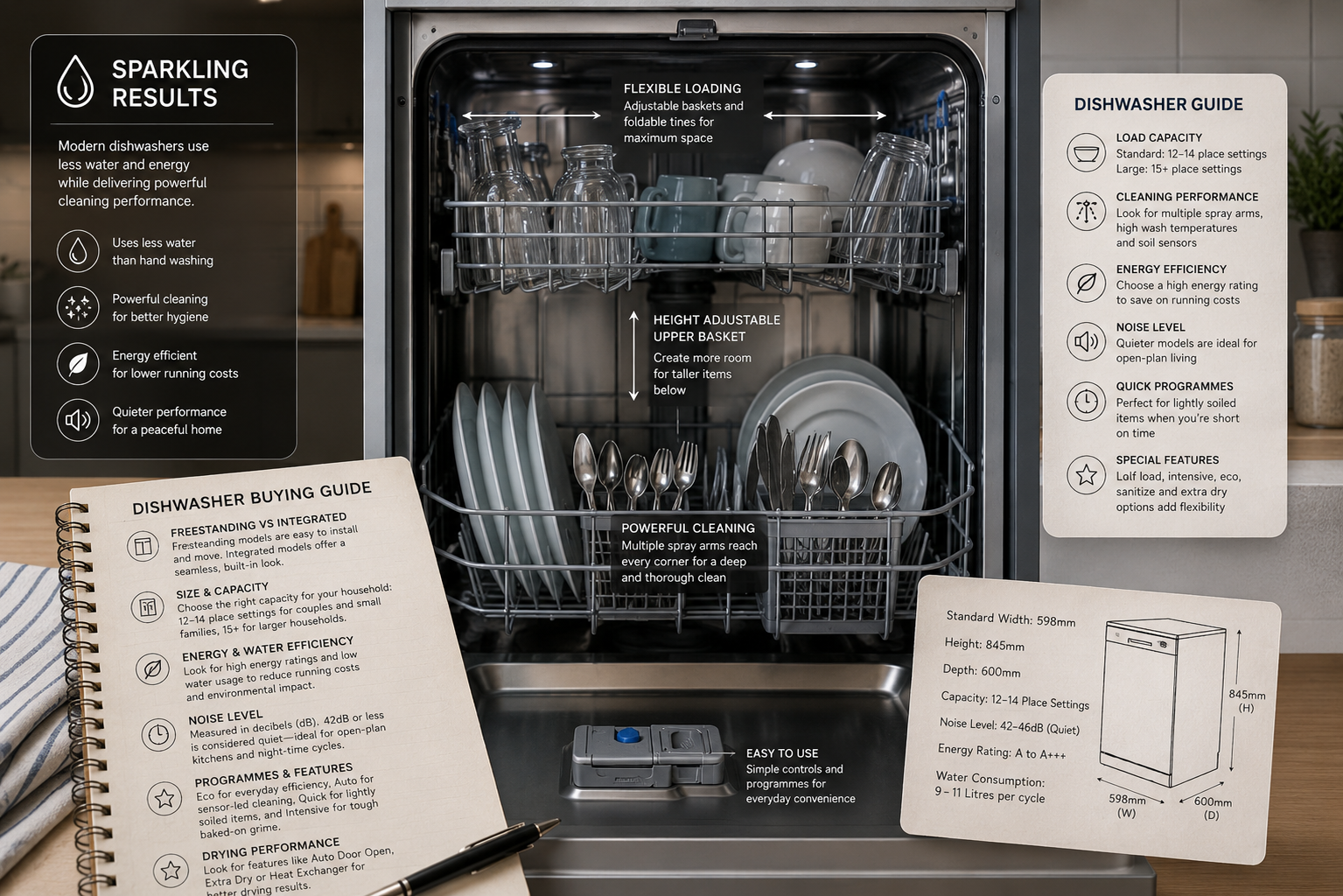
Dishwasher Buying Guide
A good dishwasher is one of the hardest-working appliances in the kitchen. It saves time, reduces washing up, keeps worktops clearer, and can often use less water than washing dishes by hand. Whether you are replacing an old dishwasher, planning a new kitchen, or looking for a quieter and more efficient model, understanding the different types and features available will help you choose the right appliance for your home.
Modern dishwashers are available in a wide range of styles, sizes and specifications, from fully integrated dishwashers and freestanding dishwashers to slimline models and compact dishwashers. With features such as adjustable baskets, cutlery trays, quiet operation, quick wash programmes, automatic door opening and improved drying technology, today’s dishwashing appliances are designed to make everyday kitchen life easier and more efficien
Freestanding vs Integrated Dishwashers
One of the first decisions to make is whether you want a freestanding dishwasher or an integrated dishwasher.
Freestanding dishwashers are visible appliances with their own front door and control panel. They are usually easier to install, easier to replace, and can often be moved more simply if your kitchen layout changes. Freestanding dishwashers are a practical choice for existing kitchens, utility areas, rental properties, or homes where a built-in appliance is not required. Many freestanding dishwashers also come in premium finishes such as stainless steel or black steel, which can be the reason for choosing this form of dishwasher over an integrated appliance.
Integrated dishwashers are designed to sit behind a kitchen furniture door, creating a cleaner and more streamlined look. These have become increasingly popular, especially in modern fitted kitchens where customers want appliances hidden from view. A fully integrated dishwasher is concealed behind a cabinet door, with controls usually located along the top edge of the appliance door. Once closed, it blends in with the rest of the kitchen.
Semi-integrated dishwashers are less common but still available in some ranges. These are partly hidden behind a furniture panel, with the control panel remaining visible at the top.
For a new fitted kitchen, an integrated dishwasher is often the preferred choice because it gives a neater, more coordinated finish. For a straightforward replacement or flexible installation, a freestanding dishwasher may be the simpler option.
Dishwasher Sizes & Place Settings
Dishwashers are usually described by their width and number of place settings. A place setting is a standard measurement used to describe how much crockery, cutlery and glassware the dishwasher can hold.
Full-size dishwashers are usually around 60cm wide and are the most popular option for family homes and regular daily use. They typically offer the largest capacity and the widest choice of features.
Slimline dishwashers are usually around 45cm wide and are ideal for smaller kitchens, couples, flats or households where space is limited. They still offer useful capacity, but the narrower interior means they may not suit larger pans, baking trays or full family loads as comfortably as a full-size model.
Compact dishwashers are smaller appliances designed for very limited spaces. These can be useful where a full-size or slimline dishwasher is not possible, although capacity is more limited.
When choosing a dishwasher, think about how many people live in the home, how often you cook, and whether you regularly wash larger items such as pans, oven dishes, chopping boards and baking trays. A larger-capacity dishwasher can be more practical, but only if you have the space and will make use of the extra capacity.
Cutlery Tray vs Cutlery Basket
Dishwashers usually use either a traditional cutlery basket or a separate cutlery tray at the top of the appliance.
A cutlery basket sits in the lower basket and is easy to load quickly. It can be useful for larger utensils and is familiar to most people. However, it does take up space in the bottom basket, which can reduce room for plates, bowls and pans.
A cutlery tray is a shallow third level at the top of the dishwasher. Cutlery is laid out separately, which can improve cleaning and drying because items are not bunched together. It also frees up space in the lower basket, giving more room for plates, saucepans and larger items.
Many higher-spec dishwashers now include flexible or adjustable cutlery trays, allowing sections to slide, fold or lower to make room for taller glasses or utensils below. For many customers, a cutlery tray is one of the most useful upgrades because it improves loading flexibility and makes better use of the dishwasher’s internal space.
Dishwasher Noise Levels
Noise level is a major consideration when buying a dishwasher, especially in open-plan kitchens, kitchen-diners and homes where the dishwasher may run in the evening.
Dishwasher noise is measured in decibels, often shown as dB on the appliance specification. As a general guide, a dishwasher around 44–46dB is fairly quiet, while models around 40–43dB are usually considered very quiet. Premium dishwashers may include special quiet programmes or extra insulation to reduce operating noise further.
This is especially important if your kitchen is close to a living space, dining area or bedroom. A quieter dishwasher can make a noticeable difference in everyday use, particularly if you like to run the appliance overnight or while relaxing nearby.
Water & Energy Efficiency
Modern dishwashers are designed to use water and energy efficiently. In many cases, a dishwasher can use significantly less water than washing a full load by hand, particularly when the appliance is fully loaded and used on an efficient programme.
Eco programmes are designed to reduce water and electricity use. They often take longer than standard cycles, but they can be more efficient for everyday loads. Many dishwashers also include sensors that detect how dirty the water is and adjust the wash accordingly, helping reduce unnecessary water and energy use.
When comparing dishwashers, look at:
• Energy rating
• Water consumption per cycle
• Eco programme running time
• Drying performance
• Capacity and place settings
• Auto or sensor wash options
A more efficient dishwasher may cost more to buy, but it can help reduce running costs over time, especially in households that use the dishwasher frequently.
Drying Performance
Drying performance can vary noticeably between dishwasher models. Some dishwashers use residual heat from the wash cycle, while others include improved drying systems to help remove moisture from crockery, glasses and plastics.
Automatic door opening is a popular feature on many modern dishwashers. At the end of the cycle, the door opens slightly to release steam and allow fresh air in, helping improve drying results and reduce condensation.
Some premium dishwashers also include enhanced drying technology for glassware, plastics and awkward items that typically hold water. This can be useful if you regularly wash lunchboxes, plastic containers, baby items or reusable bottles.
It is worth remembering that plastic items are naturally harder to dry than ceramic or glass because they do not retain heat in the same way. A better drying system can help, but loading position and programme choice still make a difference.
Useful Dishwasher Programmes & Features
Modern dishwashers include a wide range of programmes and convenience features. The most useful ones are usually the features that genuinely match your daily routine.
Common dishwasher features include:
• Quick wash programmes for lightly soiled items
• Eco programmes for lower energy and water use
• Intensive programmes for pans and heavily soiled dishes
• Auto programmes that adjust the wash based on the load
• Half-load or zone wash options
• Adjustable upper baskets for taller glasses or plates
• Foldable tines for pans and serving dishes
• Cutlery trays or flexible cutlery storage
• Delay start timers
• Time remaining indicators
• Automatic door opening for improved drying
• Interior lighting on selected premium models
• Smart app connectivity on some models
While long feature lists can look impressive, the most important things to consider are cleaning performance, loading flexibility, drying results, noise level and whether the dishwasher is easy to use every day.
Cleaning Performance & Loading Flexibility
A dishwasher’s cleaning performance is not just about power. Basket design, spray arm coverage, water pressure, filter design and programme choice all affect how well the appliance cleans.
Flexible basket systems can make a big difference. Adjustable racks, folding supports and movable cutlery trays allow you to load larger plates, tall glasses, oven dishes and pans more easily. This is especially useful in households that cook regularly or use a wide variety of crockery and cookware.
Before choosing a dishwasher, it is worth thinking about the items you wash most often. If you use large dinner plates, tall wine glasses, baking dishes or bulky pans, check the internal layout carefully rather than judging capacity by place settings alone.
Finding the Best Dishwasher for Your Home
The best dishwasher should fit your kitchen, suit your routine and make daily clean-up easier. A fully integrated dishwasher is ideal for a seamless fitted kitchen, while a freestanding dishwasher can be a practical and flexible choice for existing spaces. Slimline dishwashers are useful where space is limited, and full-size dishwashers offer the best capacity for families and frequent cooking.
When comparing dishwashers, focus on the features that matter most in real use: capacity, noise level, energy and water efficiency, drying performance, basket flexibility and ease of loading. A good dishwasher should clean thoroughly, run quietly, use resources efficiently and fit naturally into the way you use your kitchen.
About the Author


Quooker Free Installation Promotion
October 13, 2022

Manufacturer Promotional Terms and Conditions
November 12, 2022


Are Instant Boiling Water Taps The New Kettle?
June 17, 2022

Kitchen Trends
November 1, 2021

Dishwasher buying guide
May 15, 2026

Laundry buying guide
May 15, 2026

Refrigeration buying guide
May 15, 2026

Cooking appliances buying guide
May 6, 2026

Why Choose Lacanche?
April 12, 2024
